Transitioning from Documentation to Knowledge Engineering
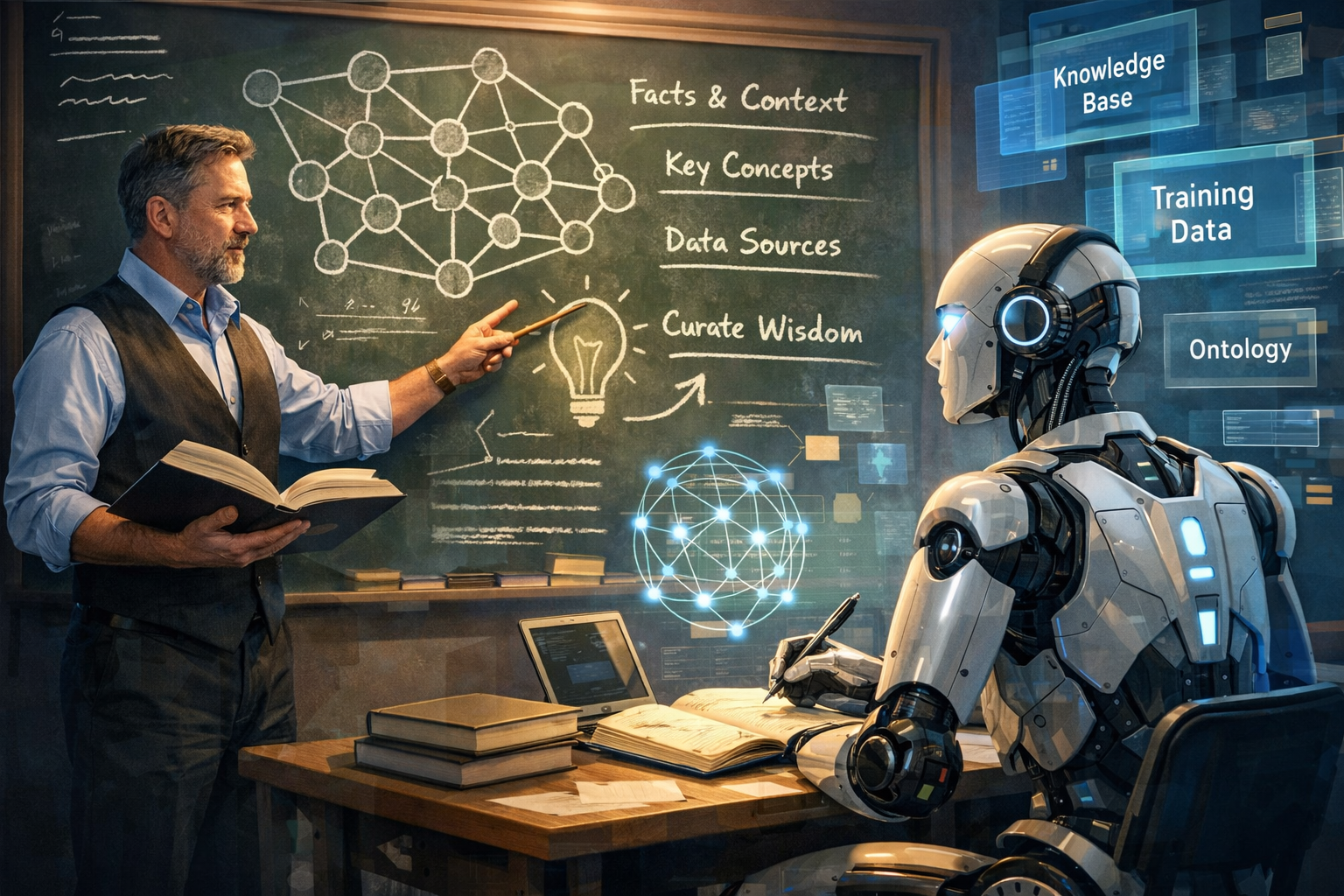
Most documentation teams are aiming at the wrong target. They think their job is to produce documents. I don’t think that anymore. I think the real job is to capture, curate, structure, and maintain truth so machines can generate documents as needed. That is a very different role, and it is a much more durable one.
For years, documentation was treated as a downstream function. Product decided, engineering built, marketing positioned, and documentation turned all of that into manuals, guides, white papers, and release content. In that model, the document was the product. That model is already breaking down.
AI is getting very good at producing coherent, structured, usable prose. It can generate summaries, guides, overviews, draft white papers, first-pass technical documentation, and marketing collateral faster than any human team. Anyone pretending otherwise is arguing with the direction of the market. The uncomfortable truth is simple: if your value is typing the final document, that value is going to compress quickly.
The teams that cling to the old model will not be protected by sentiment, tradition, or craft. They will be bypassed. That may sound harsh, but it is just the normal pattern of technological change. Society does not preserve roles because people are attached to them. Technology automates what can be automated, and the people who adapt move up the stack while the people who do not get left behind. Several times in my career I’ve worked with amazing people who were very, very good at their job – and then, that job simply evaporated. As a leader, my goal is to protect both the business and my talent from falling into that trap.
We have seen this movie before across manufacturing, operations, software development, and analyst work. Every time, repetitive production work was absorbed by tooling, and the human role shifted toward judgment, control, and higher-order decision-making. Documentation is not exempt from that pattern just because people happen to like writing.
What matters now is not authorship. What matters is knowledge and wisdom.
When I look across the outputs companies produce, I see a lot of artificial separation. We talk about engineering specs, product documentation, white papers, FAQ content, competitive collateral, website copy, internal training, and sales enablement as if they are fundamentally different creations. They are not. They are derivatives.
All of them are generated from the same underlying body of knowledge: what the product is, how it works, what it depends on, what problems it solves, where the boundaries and exceptions are, and what claims are true, supportable, and current. The output format changes, the intended audience changes, and the level of abstraction changes, but the underlying facts do not.
That is why I believe strong documentation organizations need to become knowledge engineering organizations. The job is no longer to handcraft every artifact from scratch. The job is to make sure the facts are right, the concepts are well structured, the relationships are clear, the exceptions are captured, and the knowledge is maintained with discipline. Once that foundation exists, AI can do a significant amount of the downstream production work.
That does not diminish the human role. It elevates it. Machines are good at synthesis, transformation, formatting, and speed, but they are not naturally good at truth. They do not know which source is authoritative, when two product claims are in tension, or when something is technically correct but commercially misleading. They do not understand context in the way experienced people do. They are not wise.
What people bring is judgment. They bring context. They bring the ability to decide what is authoritative, what is ambiguous, what needs escalation, and what should never be stated as fact at all. I would go further and say the future of documentation is not writing. It is applied organizational wisdom.
That has shaped how I have been evolving my own team. I have been pushing the team away from thinking of themselves as document producers and toward thinking of themselves as knowledge engineers. That means managing and creating custom expert GPTs, curating the fact base those systems rely on, capturing knowledge in a way that is explicit, structured, current, and reusable, and using AI as aggressively as possible to create the final work product we still happen to call documents.
That shift changes the work in practical ways. Instead of asking how we write a document, we ask what facts need to exist so that document and many others can be generated correctly. Instead of starting from a blank page, we start from a knowledge base. Instead of treating each asset as a standalone project, we treat it as a view into an underlying system of truth. Instead of spending most of our time polishing wording, we spend more time validating claims, resolving conflicts, improving structure, and teaching the AI how to produce better outputs.
This is a better use of human capability, and it is a more scalable operating model. Once you understand this, a lot of organizational waste becomes obvious. Companies often maintain the same fact in multiple places across engineering specs, feature guides, sales decks, launch briefs, training modules, white papers, and websites, and then act surprised when those artifacts drift apart. They drift because they were never anchored to a shared source of truth.
The conventional answer has been more process, more reviews, more content owners, and more meetings. That helps at the margins, but it does not solve the underlying problem. The underlying problem is that most organizations are managing documents instead of managing knowledge. Once you invert that model, the derivative works become much easier to produce and much easier to keep aligned.
This is why I do not view AI as a threat to documentation teams, at least not the ones willing to evolve. I view it as a forcing function that exposes whether a team’s value is really in knowledge stewardship or merely in content assembly. If it is only content assembly, AI will replace a significant portion of the work. If it is knowledge stewardship, the team becomes dramatically more strategic.
The opportunity for leaders is straightforward, but it requires intent. Most documentation teams already hold a significant amount of institutional knowledge about the product, the edge cases, the inconsistencies, and the gaps. That is not easily replaced, and it should not be discarded. The question is whether that experience is being used in the highest-value way.
Leaders should be evaluating the long-term trajectory of their documentation organizations and asking whether they are optimizing for document production or for knowledge integrity. They should recognize that their teams already possess deep corporate wisdom and product understanding, and then build a deliberate plan to transition those people toward knowledge engineering. That means investing in how knowledge is captured, structured, validated, and maintained, and in how AI systems are trained to use it responsibly.
The teams that make this transition will not be displaced by AI. They will be the ones shaping how AI creates value inside the organization. They will move from producing content to governing truth, and that is a much stronger and more defensible position over time.
Who?
 | CPO for Securonix. Formally CPO for SecurityScorecard and Reveald, EVP Cybersecurity Mastercard, Chief Technology Officer for Intel Secure Home Gateways, CTO for McAfee Enterprise Endpoint, CTO McAfee Innovation team, and Founder/CTO SafeBoot Corp. |
 Simon Says - Musings of a Technology CTO
Comments